You have certainly noticed it, or perhaps someone has already told you. Even though ceramic hobs and induction hobs may look similar, they should not be confused. In your opinion, what differentiates one from the other? In this article, we clarify the point.
Ceramic Hobs
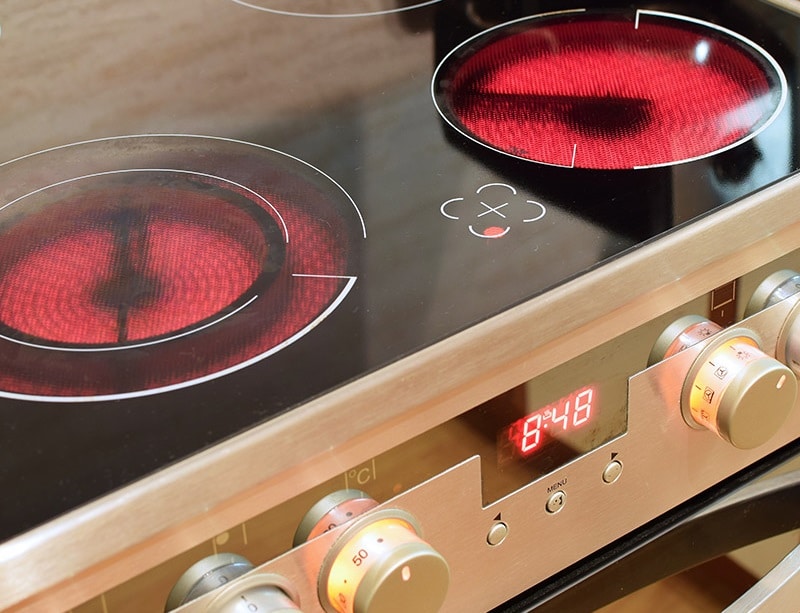
There is a significant difference between induction and ceramic. Ceramic cooktops have advantageously replaced older electric hobs. These ceramic hobs allow for more precise temperature control, in addition to enabling a quicker rise in temperature. Furthermore, these hobs are also more aesthetically pleasing as they are covered with tempered glass and are perfectly smoother, offering great ease of maintenance. Here, a simple wipe with a sponge is enough! So if you are looking for a practical and cheaper cooktop, ceramic is ideal.
Today, there are also ceramic hobs that work with high-light radiant elements. These heat even faster than traditional ceramic cooktops. Finally, there are certain ceramic cooktops that operate with halogens. They provide an even faster temperature rise.
Induction Hobs
Induction cooktops work thanks to a magnetic field that is activated by the metal of the pot. Thus, only the part that is in contact with the pot heats up. Moreover, when you remove the pot, the cooktop turns off.
Additionally, this high-end cooktop has many advantages that allow you to cook like a true chef. The first advantage is induction. Thanks to it, there is a rapid rise and fall in temperature. For example, if the milk is about to boil over, a simple press on the control panel will prevent the disaster. Similarly, to boil a large amount of water, just a few minutes will suffice.
Furthermore, today, the majority of induction hobs are equipped with electronic timers that automatically cut off the power to the cooktop once the cooking time is up. The best part is that some hobs have a timer for each zone. This allows you to manage the cooking of each dish you need to prepare independently.
Regarding energy consumption, induction hobs are one third less energy-consuming than ceramic hobs. Some induction hobs are even 50% less energy-intensive than a gas cooktop. The reason is that heat is produced only when the container is in contact with the element. Thus, there is no energy loss. The last advantage is the cleaning of the induction cooktop. It offers real ease due to the extra flat surface of the cooktop, which has no roughness. Then, since the area around the pot is cold, food splatters dry without cooking.