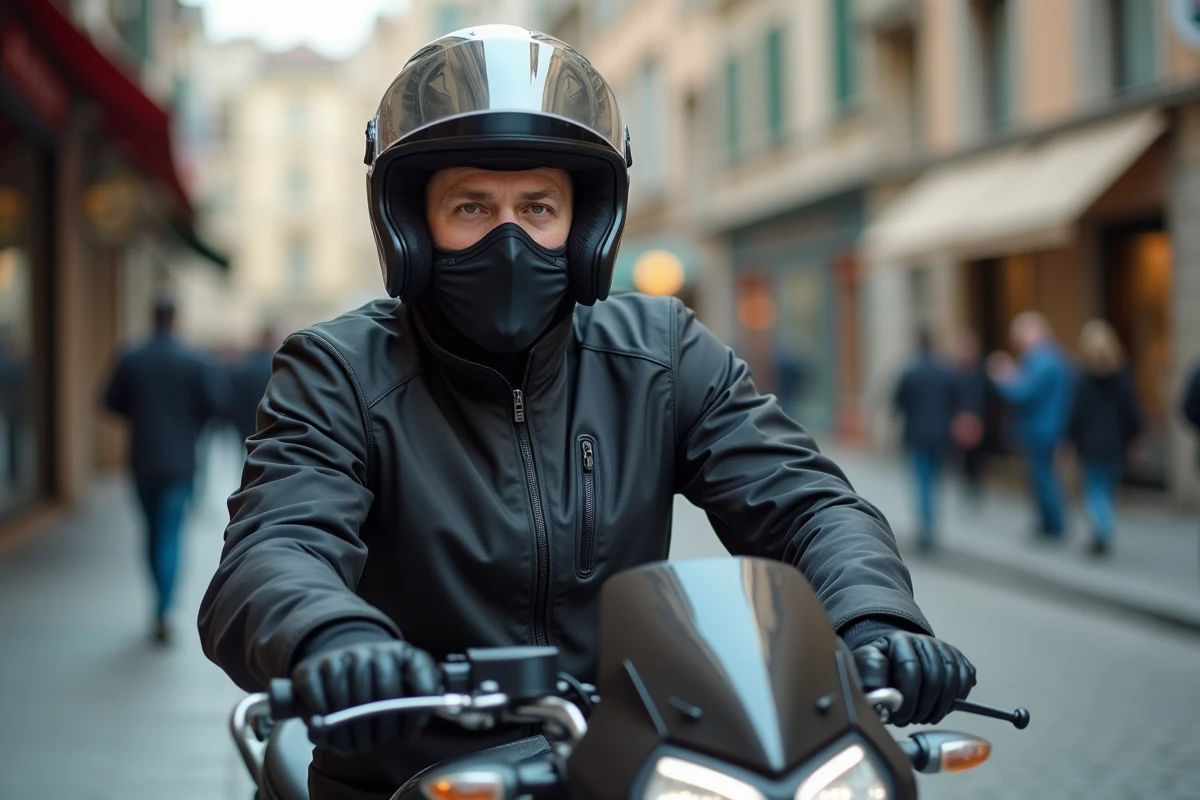
A motorcyclist putting on a balaclava before fastening their full-face helmet at 3 °C is not thinking about the law. They are thinking about the cold seeping in at the neck and cheeks. The legal question comes later, often after a roadside check or a comment on a forum. Knowing whether the motorcycle balaclava is prohibited or allowed, and whether it falls under the Penal Code or the Highway Code, changes the way to approach the situation.
Law on face concealment and motorcycle balaclava: two distinct logics
Law No. 2010-1192 prohibits face concealment in public spaces. Articles R.645-14 and R.645-15 of the Penal Code outline the penalties. On paper, a textile balaclava that covers the face falls under this text.
In practice, the balaclava worn under a certified helmet is not targeted. Several prefectures, including the Paris Police Prefecture, specify in their FAQs that this prohibition does not apply to motorcycle riders as long as wearing a helmet is mandatory and the face can be revealed during a check.
The nuance lies here: we are talking about a tolerance related to the legal obligation to wear a helmet, not a formal exemption written into a decree. If one wears a balaclava alone, without a helmet, on a scooter or mini-motorbike in the city, the framework changes. Since 2022, motorcycle unions and driving schools have reported an increase in fines for face concealment in this specific case.
To know precisely whether the motorcycle balaclava is prohibited or allowed depends on the context of use, it is necessary to cross-reference the Penal Code and the Highway Code.

Road check with a motorcycle balaclava: how to react
You find yourself on the side of the road, an officer asks you to uncover your face. The expected reaction is simple: lift the visor, remove the balaclava from your face, present your documents. There is no obligation to remove the full helmet as long as the face is identifiable.
Staying calm and showing your face without delay is sufficient in the vast majority of situations. Responses vary on this point depending on the regions and officers, but the principle remains the same: immediate cooperation cuts short any suspicion of intentional concealment.
What can pose a problem:
- Wearing an opaque full balaclava without a helmet over it, which does not correspond to any legitimate motorcycle use in the eyes of law enforcement
- Refusing to uncover or delaying, which turns a simple check into a tense situation
- Using a balaclava whose fabric makes quick removal difficult (very fitted models with narrow openings), as the officer may interpret the slowness as a refusal
Insurers and motorcycle balaclava: an angle that motorcyclists underestimate
The legality of the balaclava does not guarantee peaceful coverage in the event of an accident. Since 2023, several insurers (MAIF, MACIF, Mutual of Motorcyclists) mention in their winter prevention sheets that a balaclava reducing lateral vision or partially blocking hearing can be considered a aggravating factor during a post-accident assessment.
This does not mean an automatic denial of compensation. It refers to an additional element that the expert can use to adjust liability. Specifically, if the balaclava worn hinders head rotation in the helmet or creates an additional blind spot, the insurer has a lever.
Choosing a balaclava that does not compromise safety
The practical reflex is to check three things before buying:
- The facial opening must be wide enough not to reduce peripheral vision once the helmet is on
- The fabric around the ears must remain thin enough to maintain a correct perception of traffic sounds
- The overall thickness must not alter the fit of the helmet, as a helmet that moves on the head in the event of a shock loses much of its protective effectiveness
Models made of fine technical fabric (like microfiber or synthetic silk) meet these criteria better than thick fleece balaclavas, which inflate the inside of the helmet and force the chin strap to be loosened.
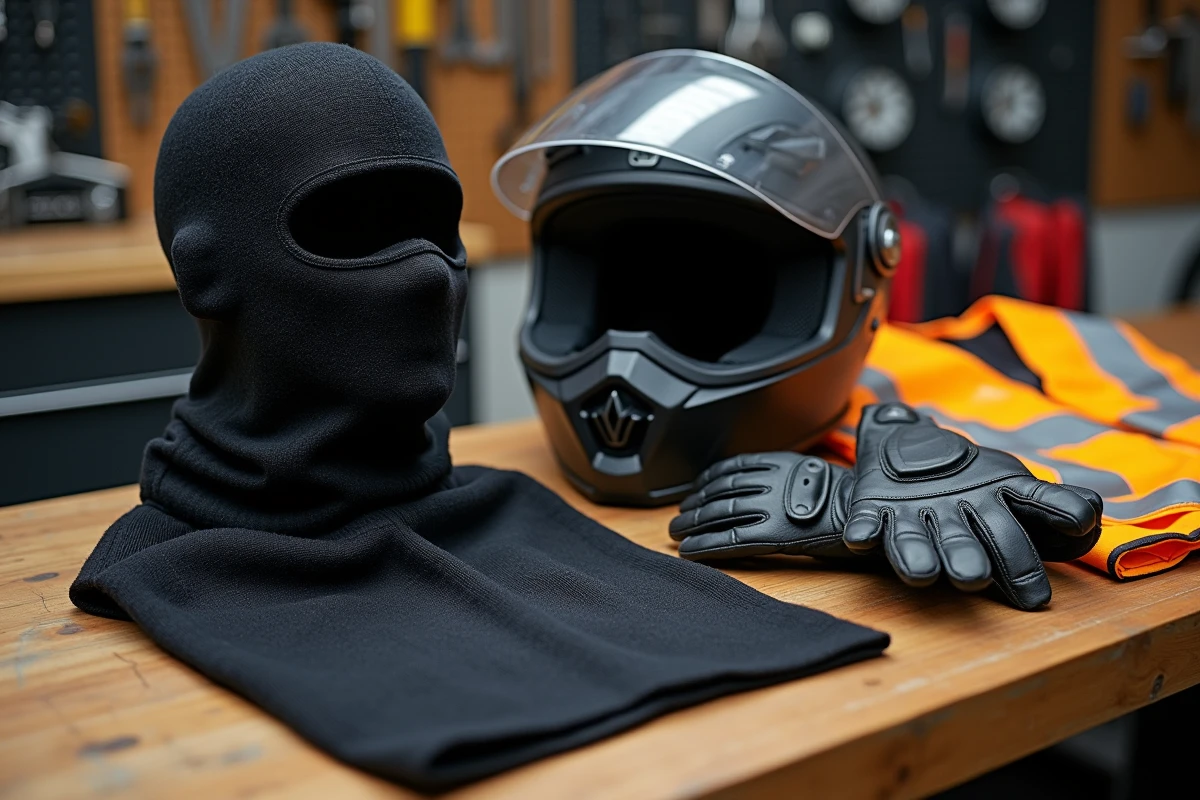
Mandatory motorcycle equipment: reminder of penalties
The balaclava is neither mandatory nor explicitly prohibited in the Highway Code. However, a certified helmet, CE-certified gloves, and a high-visibility vest (to be kept on oneself or in storage) are required by law.
Not wearing a helmet exposes one to a fine of up to €750 and a deduction of 3 points. The absence of certified gloves also results in a fine. These penalties apply to both the rider and the passenger.
In this context, the balaclava remains a thermal comfort accessory. It does not replace any regulatory equipment and does not exempt one from it. Wearing a balaclava without a helmet over it does not provide legal or physical protection.
Visibility and comfort in winter: balancing without compromising safety
In cold weather, we layer up. The classic trap for motorcyclists in winter is to sacrifice neck mobility for warmth. A neck warmer that is too thick combined with a balaclava and a modular helmet creates rigidity that slows down blind spot checks.
It is better to invest in a thin balaclava and a separate neck warmer that can be adjusted according to the temperature, rather than concentrating everything on a single thick piece. Road safety on a motorcycle relies as much on the ability to turn the head freely as on the quality of the helmet itself.
The question of the motorcycle balaclava boils down to a practical principle: worn under a certified helmet, it does not pose a legal problem as long as one agrees to show their face upon request. The real risk is not legal; it is functional. A poorly chosen balaclava degrades the protection of the helmet and the perception of the environment, two elements that no motorcyclist should compromise on.