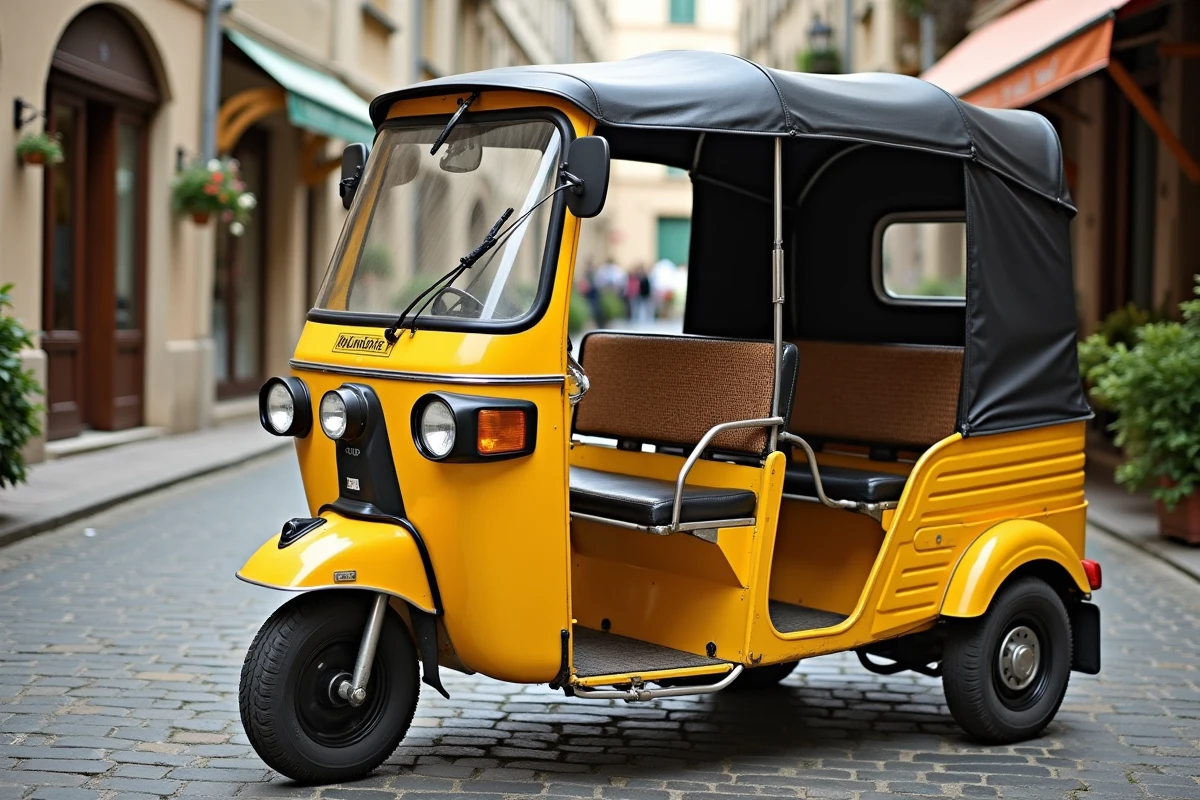
A three-wheeled vehicle, open on the sides, that transports passengers through the streets of Bangkok or Lisbon: everyone visualizes a tuk tuk. Transposing this concept to France raises very concrete questions about administrative categories, homologation, and profitability. Before signing an order form, it is better to understand the legal framework in which this vehicle operates on French territory and what that implies on a daily basis.
Administrative category of the tuk tuk: a costly blur
In France, the tuk tuk does not have a dedicated category in the highway code. It is classified under the category of motorized vehicles with two or three wheels (VMDTR), which subjects it to the same obligations as a three-wheeled scooter or a heavy motorized tricycle.
Why does this classification pose a problem? Because a tuk tuk transports passengers seated in the back, often for a fee. This activity shifts it into the scope of Public Transport of Persons (T3P), just like a VTC or a taxi. The operator must then obtain a prefectural authorization, demonstrate financial capacity, and subscribe to professional civil liability insurance.
A proposed law submitted to the Senate aims to assimilate tuk tuks to small tourist trains under certain conditions, which would exempt them from T3P constraints. If this text is passed, operators in coastal or tourist areas would benefit from simpler administrative processes. For now, the legal ambiguity remains, and each prefecture interprets the rules in its own way.
Anyone considering buying a tuk tuk in France must therefore check in advance the position of their local prefecture, as requirements vary from one department to another.

Municipal decrees and ZFE: very local restrictions to anticipate
You have spotted an approved electric model, your prefectural file is ready. One question remains rarely addressed in general guides: does your municipality actually allow the circulation of a tuk tuk in its streets?
Several major French cities have adopted municipal decrees limiting tuk tuk access to city centers or pedestrian zones. Bordeaux and Nice, for example, regulate this activity with time slots and license quotas. The tuk tuk is sometimes classified there as a “tourist vehicle with driver” or “event vehicle,” depending on local terminology.
The extension of Low Emission Zones (ZFE) adds a layer of complexity. A thermal tuk tuk may be prohibited from accessing certain neighborhoods if its Crit’Air sticker does not meet local criteria. Electric models pass this filter without difficulty, but their purchase price is significantly higher.
Points to check with the town hall before any purchase
- Existence of a municipal decree regulating tuk tuks or three-wheeled tourist vehicles, with possible authorized circulation time slots
- ZFE classification of the targeted operating area and Crit’Air sticker required for thermal models
- Quota of licenses already issued and specific application procedure, which may differ from the standard VTC procedure
Homologation and maintenance: the real cost of a tuk tuk in France
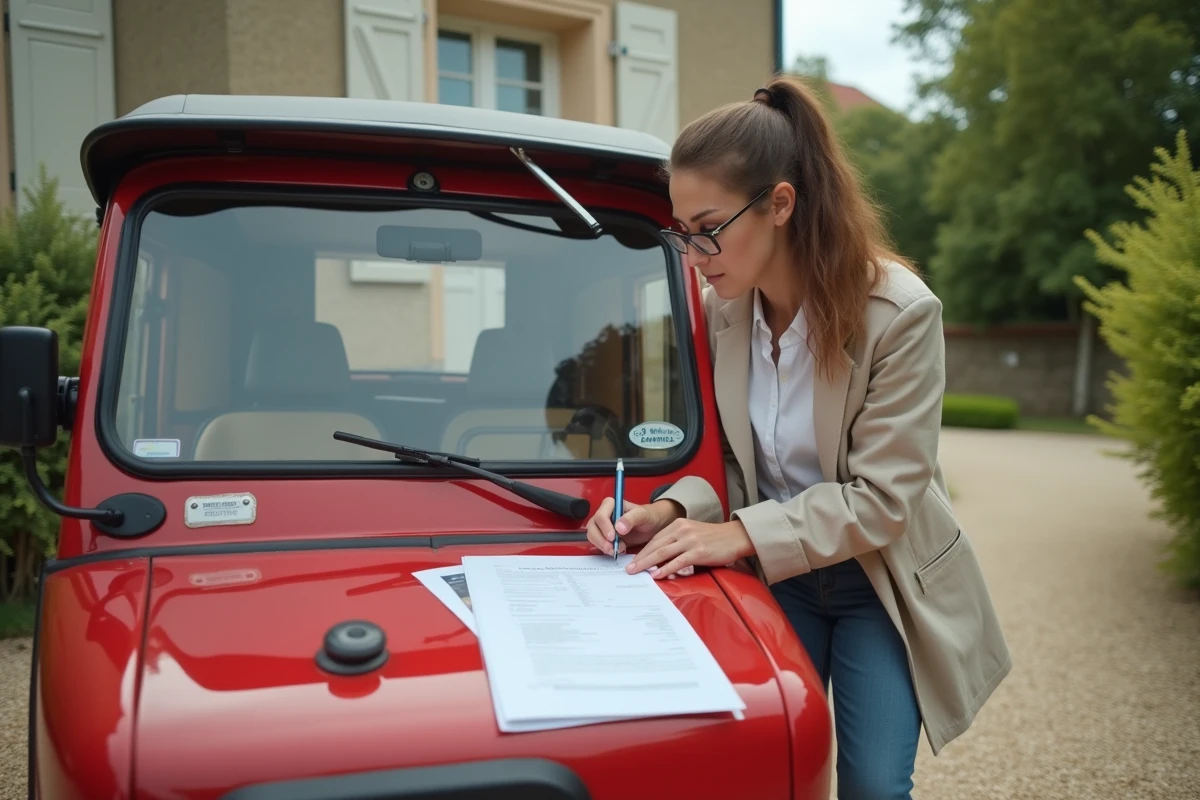
The catalog price of a tuk tuk reflects only part of the actual budget. The individual homologation of an imported vehicle (often from Southeast Asia or China) represents an expense that many project holders underestimate.
To circulate legally, the tuk tuk must obtain a single approval (RTI) issued by the DREAL. This procedure checks compliance with European safety standards: braking, lighting, protective structure, noise level. Some models sold online do not pass this stage without costly modifications.
Regular maintenance poses another challenge. Spare parts are not available from a regular mechanic. User feedback on specialized forums highlights the difficulty of finding a mechanic trained on these vehicles. Electric models simplify the mechanics (fewer moving parts), but the battery remains an expensive component to replace.
Electric or thermal: a decision that depends on the terrain
An electric tuk tuk is suitable for short routes in the city center, typically tourist circuits of a few kilometers. Its autonomy remains limited, and fast charging stations are not always suitable for this type of vehicle.
A thermal model offers more flexibility for suburban or hilly trips, but it is subject to ZFE restrictions and generates higher fuel costs. The choice primarily depends on the intended operating area, not on an abstract technical preference.
Tuk tuk as a professional tool: profitable use cases and dead ends
The tuk tuk attracts a variety of profiles: local tour operators, mobile caterers, event renters. Not all experience the same success.
- Guided tourist tours in season remain the most proven model, with a decent occupancy rate in cities with high summer traffic
- Street vending (food truck version tuk tuk) works at occasional events, but the vehicle’s limited storage capacity severely constrains revenue
- Transporting employees on private sites (campuses, industrial zones) is emerging as a marginal but recognized use, with some companies integrating this mode into their Sustainable Mobility Package
- Peer-to-peer rental remains anecdotal, hindered by insurance and liability in case of accidents with passengers
Profitability relies on a sufficient volume of rides during the high season and strict control of fixed costs, particularly professional insurance and maintenance.
Buying a tuk tuk in France is not an impulsive purchase. Between the DREAL approval, municipal decrees, ZFE constraints, and the availability of parts, each step requires prior verification with local authorities. The best-chosen vehicle is the one whose operation has been administratively validated before the order, not after.