
On Beninca motors, the manual disengagement procedure is poorly documented compared to other manufacturers. However, the mechanism exists on almost the entire range, including sliding models like the KBULL8M. Here we detail the exact handling, common diagnostic errors, and points of caution during re-engagement.
Key disengagement on Beninca motors: location and manipulation of the cylinder
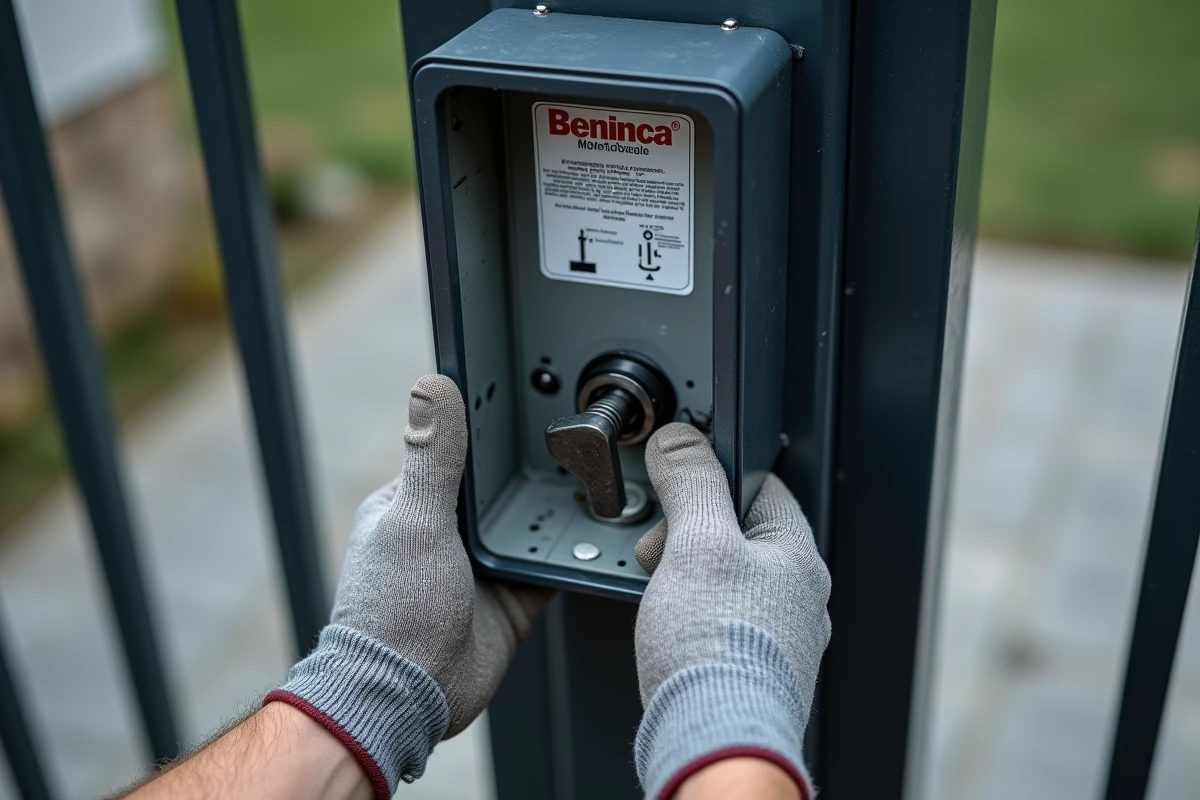
The secure manual unlocking by key is standard on Beninca motors. On arm or sliding models, the cylinder is located directly on the motor housing, often protected by a plastic cap that needs to be removed or rotated.
The key provided with the kit (triangular key or flat key depending on the series) operates an internal bolt that disconnects the motor pinion from the rack or arm. Once disengaged, the leaf can move freely by hand. On the KBULL8M, the cylinder is positioned on the front face of the motor block, accessible without tools.
We recommend testing this operation in a non-emergency situation. The disengagement key should be kept in a location accessible from outside the property. Many users store it inside the electronic box, which renders it useless in case the gate is stuck in the closed position.
A complete guide explains how to manually open a Beninca electric gate according to the different series of the brand, with variations in cylinder positioning.
Power failure or faulty electronic board: distinguish between the two before intervening
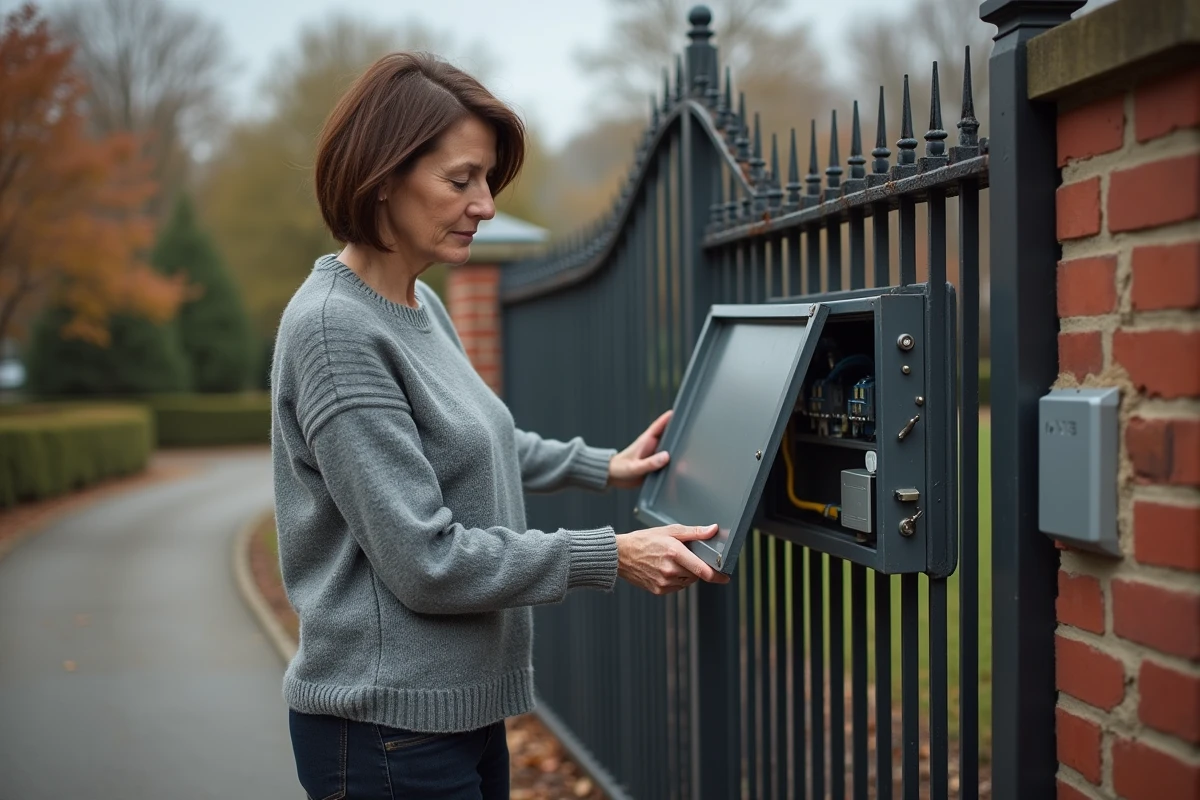
In the field, confusion between power outages and electronic failures is common. Several users of Beninca motors report power present at the terminal but a gate that refuses to operate. In this case, the failure does not come from the electrical network but from the electronic board or the motor itself.
Before disengaging, a quick check is necessary. If the control board light is on, the power supply is functional. The problem is then downstream: motor capacitor, burnt board, faulty photoelectric cells, or poorly adjusted limit switch.
Manual disengagement remains the only immediate solution to enter or exit, regardless of the cause of the failure. But correctly identifying the cause avoids calling a technician for a simple Enedis outage, or conversely, re-energizing a motor whose board is short-circuited.
- Board light off, no voltage at the terminal: power outage confirmed, disengagement is sufficient while waiting for power to return.
- Board light on, motor silent: motor or capacitor failure, technical intervention needed after disengagement.
- Board light on, motor runs but gate does not move: mechanical problem (rack disengaged, broken arm), mechanical check required.
- Board light flashing in rapid sequence: manufacturer error code, consult the Beninca manual to identify the reported fault.
Re-engagement after power restoration: the sequence to follow on Beninca
Re-engagement is the phase that manuals gloss over and that users most often miss. On a Beninca motor, putting the key back in position and turning it is not always enough to re-engage the pinion.
The leaf must be placed in the end-of-travel position (open or closed depending on the model) before turning the disengagement key in the opposite direction. If the gate is left in an intermediate position, the pinion and rack do not align, and the motor strains on the next start. On arm models, the articulated arm must be manually returned to the mechanical locking point.
After re-engagement, we recommend a complete open-close cycle in step-by-step mode (short pulse on the remote control) to verify that the travel is correct. If the motor stops mid-travel or reverses direction, the end-of-travel learning procedure must be restarted from the electronic board.
Resetting the limit switches after prolonged disengagement
On some Beninca boards, a disengagement lasting several hours causes the stored position references to be lost. The gate then performs an incomplete first cycle or gets stuck halfway. The reset involves the sequence described in the board manual (usually a long press on the programming button, followed by a complete cycle in learning mode).
Do not confuse this recalibration with a motor fault. A technician called for this type of symptom will charge for a repair when a simple travel re-learning resolves the issue.
Beninca backup battery: reduce reliance on disengagement
The backup battery option offered by Beninca or by third-party installers connects directly to the control board. It takes over in case of a power outage and allows the gate to be operated normally via the remote control, without going through mechanical disengagement.
Autonomy depends on the battery model and the frequency of cycles. On a residential installation with a few openings per day, the battery generally covers several hours of outage. Beyond that, manual disengagement remains the fallback.
Installing a battery does not eliminate the need to keep the disengagement key accessible. A discharged or faulty battery produces exactly the same result as a complete power outage. Specialized installers in Beninca automation increasingly integrate this option as standard, significantly reducing the need for emergency disengagement.
Lastly, a point often overlooked: check the charge of the backup battery at least once a year. An unused lead battery for months can lose its capacity without any indication on the board. A simple test of intentional power cut at the circuit breaker allows for validating its proper functioning before a real failure occurs.