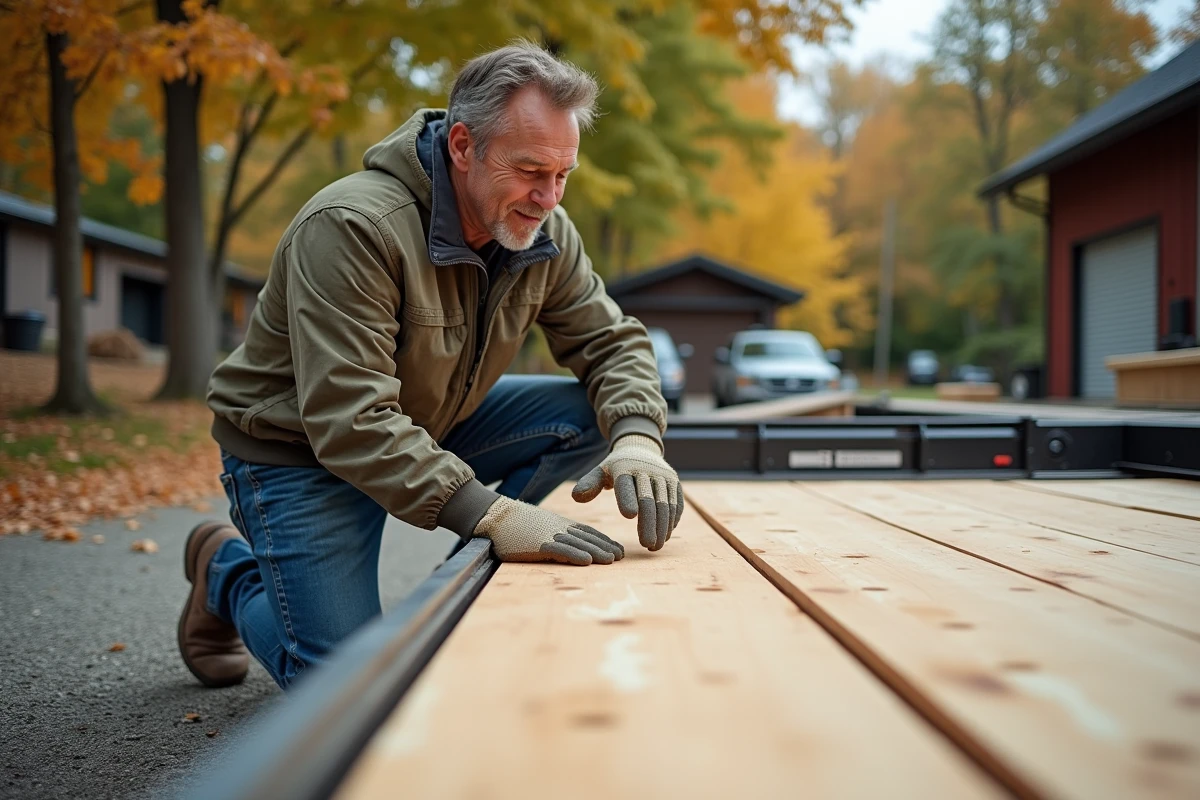
Marine plywood withstands repeated exposure to moisture without warping or deteriorating, where most traditional wood panels quickly show their limits. However, road safety regulations do not require the use of this material, creating a gap between the practices of professionals and the choices of individuals.
The criteria for selecting a trailer floor vary greatly depending on the intended use, budget, and exposure conditions. This diversity of technical options, often misunderstood, leads to installation errors or premature aging of the floor.
Overview of materials for trailer floors: advantages and limitations
It is impossible to choose blindly from the range of trailer floors. Each material imposes its own rules. Solid wood, composites, synthetic panels: all have distinct characteristics, but few can withstand rain and impacts over time. Solid wood initially attracts with its robustness, but moisture and temperature fluctuations accelerate cracks, warping, and degradation, even in species known for their strength. Composite or synthetic materials, on the other hand, are lighter but do not match the mechanical resistance or durability of rigorously selected and treated wood.
The family of plywoods reveals a finer technical range. Exterior plywood, based on species like maritime pine, spruce, or mahogany, bonded with special glues (phenolic resin, WBP glue), withstands moisture adequately. But as soon as conditions become extreme, structural stability shows its limits. Some variants (fireproof, film-faced, non-slip, bendable, structural) target specific needs, without always offering the versatility expected for a trailer floor.
Marine plywood, however, takes the advantage. Its secret? A multi-layer assembly of tropical hardwoods like okoumé, teak, or birch, reinforced with waterproof phenolic glues. This ultra-strong design guarantees remarkable dimensional stability, water resistance, and durability that leave standard plywood far behind. This material lends itself to various uses: trailer floors, vehicle fittings, nautical projects, outdoor applications. The term marine plywood for trailer brico dépôt illustrates a concrete demand: to obtain a reliable, certified panel capable of facing the road and the elements, while ensuring a perfect fixation for confident driving.
Before making your choice, take the time to check the thickness of the panel, the type of glues, the quality of the veneer, as well as the presence of recognized certifications (FSC, PEFC, EN standards). A good floor is not limited to its water resistance: it combines strength, ease of maintenance, and adaptation to transport constraints. These criteria truly make a difference over time.
Why does marine plywood make a difference for your trailer?
What distinguishes a reliable trailer floor is indeed the nature of the material. With marine plywood, we rely on demanding manufacturing: several layers of tropical hardwoods, okoumé, teak, sometimes birch, compressed and glued with phenolic resin, a glue that fears neither water nor persistent humidity. The result: a dimensional stability that holds strong, even after years of weather and temperature variations.
This material is not afraid of fungi, rot, or mold attacks. Perfect for a trailer, it withstands the stresses of transport and external aggressions without flinching. Another argument: its lightness, which facilitates the management of the GVW (gross vehicle weight), optimizes the payload, and enhances road safety. Different thicknesses are available, from 3 to 40 mm, allowing for adjustments: floor for heavy loads, vehicle fittings, or even custom shelf creation.
Quality also lies in traceability. Marine plywood often displays certifications (FSC, PEFC, BS 1088, EN 314 or EN 636 standards) that attest to responsible forest management and serious manufacturing. Some models go further, receiving an antifungal or eco-friendly treatment, with formaldehyde-free glues. This combination of criteria makes marine plywood a solid and reliable choice, capable of lasting even under intensive use or in extreme conditions.

Expert tips for choosing and installing a durable wooden floor
Material choice: prioritize robustness and stability
Marine plywood impresses with its moisture resistance and durability, but the thickness of the panel remains a key parameter. For a trailer, aim for between 15 and 30 mm, adjusting according to the weight transported and frequency of use. A panel that is too thin will wear out too quickly, while one that is too thick will unnecessarily weigh down the vehicle. Be sure to check the certification (EN 314, EN 636, FSC) to ensure both strength and environmental compliance.
Preparation and installation: rigor and anticipation
Before installation, it is better to store the panels away from moisture to preserve their dimensional stability. When cutting, ensure precision and allow for necessary gaps to avoid any stress due to expansion. For fastening, prefer stainless steel screws or through bolts: nothing beats this for ensuring lasting hold. Finally, apply a surface treatment, marine varnish or suitable paint, on all faces, paying particular attention to the edges, the areas most exposed to water infiltration.
To ensure the longevity of the floor, here are some points to regularly monitor:
- Frequently inspect the joints and fasteners: even the slightest water infiltration can harm the durability of your floor.
- If the trailer is heavily used, a non-slip coating improves safety and limits wood wear.
Marine plywood also appeals for its ease of maintenance. Regular cleaning and careful inspection of the edges are sufficient to keep the wood in good condition and prevent mold growth. Design and fitting professionals also appreciate it: it combines reliability and aesthetics, whether for equipping a van or designing custom shelves. Once installed, the floor remains true to its promise: robustness and peace of mind, season after season.